

Memento for a Fisherman
by Geoffrey Callahan

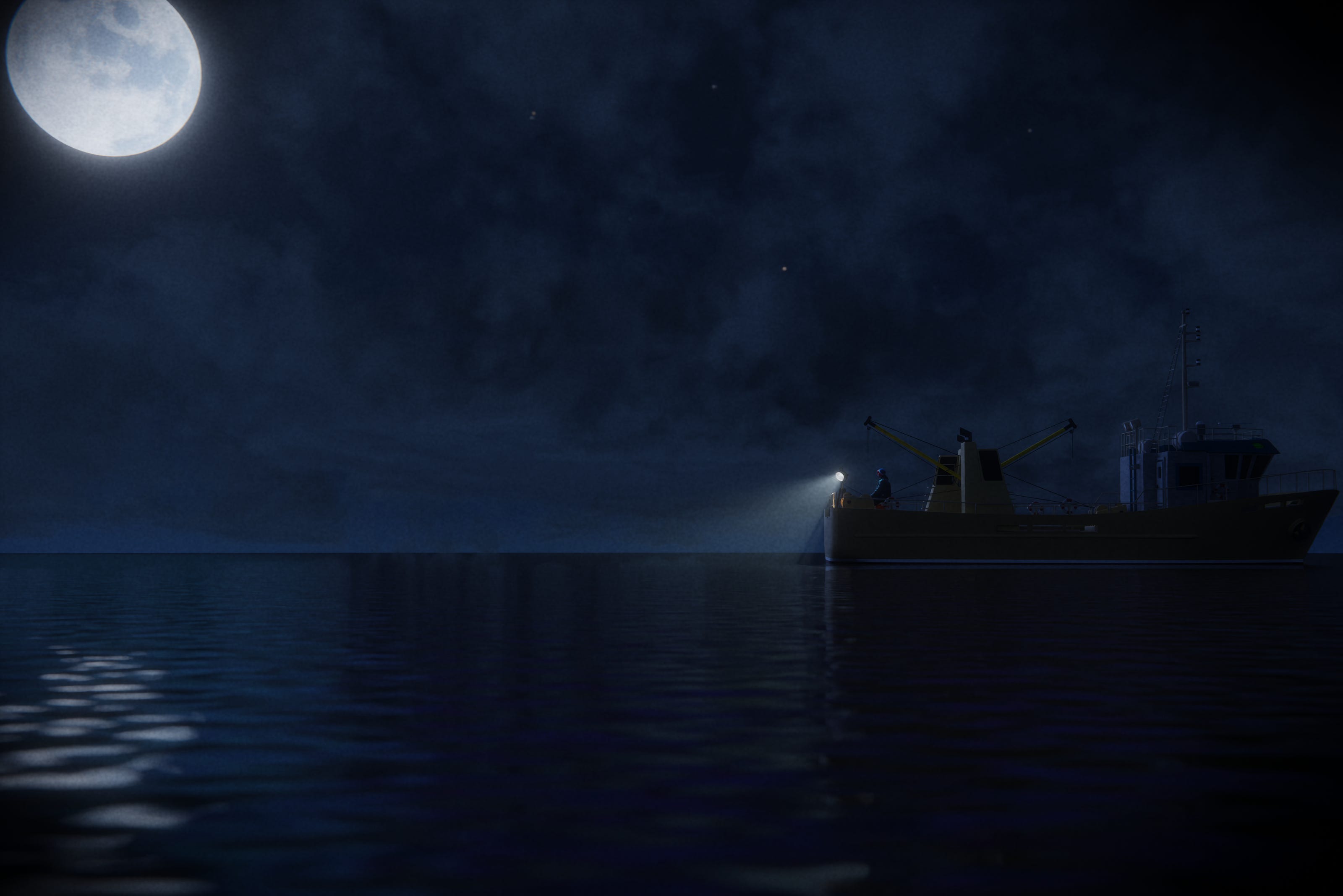
I’ve come to possess this idea, or as some might call it, a dreadful belief that I am never to know everything. As a man of facts and reason, I can only believe things that I’ve come to see firsthand, shown with a proper stance on the matter, with the belief that it’s true and certain. An absolute certainty, if you will. But before I found myself wrapped in the sciences, I never found myself pondering the things that caused me confusion. It was merely a discomfort I’d chosen to ignore, but I’d found my ideologies ruptured after what was a mere fishing trip with my uncle.
My uncle was a scientist. Well, to be more specific, he was a biologist, interested in how the laws of life worked and writhed to an end. He was certainly an odd character to grow up around, leaving me wondering how he viewed the world around him. Even at age seven, I couldn’t understand why others perceived reality as they did.
The air grew cold over the spanning water that day, so calm for it being open ocean and the middle of the night. Our small Gig drifted and parted the waters just enough to engrave our place here. A jury-rigged spotlight stood at the bow, held upright by wire and epoxy, and aimed at the water just off the port side of the vessel. With how dark and shadowed the waters it was vital to use the narrow light to see anything, but all the light did was create a finite beam down. Instead of relying upon the basic techniques a fisherman might amass, my Uncle would tell me that he was a “visual fisherman.” So when I found myself looking into the beam that leered into the deep waters, I found it odd that he would often prefer the starboard side of the boat. There, I’d see him staring at a reflection of something in the water. However, whenever I looked down at what he saw, clouds overhead would rid me of a chance to spot the enthralling image. Because of his silent, pondering approach to fishing, I’d find myself somewhat alone out on the waters. In order to prevent myself from becoming solitary, I’d use small talk to garner his attention, or at least, the best small talk a seven-year-old could muster up.
So there I was, tugging on his sleeve, saying, “Mori, can you come look here?”
“You catch something?” My uncle asked, shifting his gaze from the dark water to me.
“No,” I started, a little embarrassed that I’d been neglecting the entire reason we were out on the water. “I just wanted to ask something about your light.”
“Shoot”
“Well, I wanted to know why the light ends.”
“What do you mean?”
I dragged him over to port and pointed to the light. “There. Why can’t the light hit the bottom?”
His face scrunched in confusion, then he got a slight smile on his face. “Well, it’s simply just too deep.”
“Too deep?”
“Water reflects, refracts, and bends oncoming light. It almost acts as a shield for the bottom.”
I stood there, a little confused.“So how deep is it?”
He nearly chuckled. “Oh, just past twelve thousand feet deep.”
And while I couldn’t exactly understand why, I began to shudder. Twelve thousand feet? To my seven-year-old mind, he might as well have told me it was infinite.
“Right here?”
“Exactly here. There are even some parts where the currents might grab you and pull you further down until the icy waters consume you whole.” He finished with an emphasis you’d give when telling a campfire story.
My legs felt leaden and threatened to buckle beneath me as I stumbled back towards the middle of the boat. My small talk had done nothing but lead to my discomfort. I think at that moment, he knew I was scared. As my mind raced on about how conceivably far the ocean reached, my uncle changed his demeanor.
“Hey, what’s with that face? I’m only messing. If it makes you feel better, it’s actually rather warm the deeper you get.”
I looked back with obvious doubt.
“Really, I’m not lying,” he continued, aware of my unfaltering body language. “I’ll explain: the deeper you go, the closer you get to the core of the earth. The mantle and outer core have magma, which helps warm the water from below. Think of it as a kettle except it never boils, they heat the water just enough where the warm and cold balance out into equilibrium.”
I continued staring back, still believing he was only trying to comfort me.
“Here, let me show you something,” He began again, waving me over. I hesitantly moved back towards the edge. “It’s fine, the water’s not gonna bite. See, before making it to equilibrium, there’s a point where the water stops getting colder, and your perception changes. It’s miles down where you’ll find tropical fish swimming in the dark.”
Tropical fish up north?
“Miles?” I asked in disbelief. He took his rod and cast it back into the halogen-lit water until eventually I couldn’t see the hook, and oddly, I began to see his reel letting down much more line than I thought it ever could.
“You’ll be amazed by what I know,” he responded, allowing the line to fall for an extra minute until it pulled taut. I pressed my chest against the edge of the boat, looking intently, trying to see beyond where the light ended.
After a moment of entranced gaze, the rod pulled against my uncle’s strength, and he fought back violently. He reeled whatever it was in so fast that I began to worry that he might just break the reel handle clean off. With a final yank from my uncle, the hook came back into view, dragging something that splashed out of the water into the air. The sudden surprise sent me falling backward into the spotlight, causing it to fall into the boat and aim straight up. The light now shone on my uncle’s fishing rod, and at the end, a small, rose-red fish with dresslike fins wiggled in the open air. My uncle stood there with a deep vindication lining his face.
I was mesmerized.
I never forgot that night, for it ended up shaping how I perceived my world for the coming future, even if only temporarily. As the years moved on, my uncle stood valiantly and kept speaking of warm waters, chasing tropical fish, and fishing in the dark.
So when the news came that he’d been pulled overboard, I found myself stunned… cold. What had happened? Was the catch too big? Maybe an accident on the starboard side?
No matter, I found myself wondering if he was as warm as he claimed.
So in his honor, and to help me with my grief, I took a sunset boat into the middle of the ocean to catch myself a tropical fish. Disaster wouldn’t stray far, as I soon realized that I’d forgotten my uncle’s spotlight. How stupid of me to forget such an important piece of hardware. I’d have to fish in the dark.
Alone in the night, I was uneasy, casting and waiting for fish I couldn’t see. Though it was odd to think that even now, with a light, my uncle never actually used it for the fish he’d catch. He’d only show it off after hooking it, before throwing it back.
Now, without light or certainty in my uncle’s methods, I found myself on the starboard side of the boat, looking into the dark water to pass the time. Even now, I couldn’t see anything that caught my eye. I kept thinking back as to why my uncle fancied such darkness, even though he typically brought along a light. Unlike him, I couldn’t catch a fish in the dark.
I grew angry and sad; it became a discomfort. Soon after, my mind grew tired. A flood of static dreams washed over my visions, and a ripple began to form in the water. I looked towards what appeared to be a hole opening as water splashed around it. It was bizarre to see this pitch-black anomaly appear right in front of me, enveloping the water around it. My balance gave as my legs and eyes grew heavy, and I too slipped overboard, pitching forward into the darkness, eaten whole by the void.
Despite my best efforts, the vortex kept dragging me down until every inch of my being was surrounded by water. Each paddle and stroke rewarded me with exhaustion. How very cold the water became. The heavy pressure of a million pounds of water began to press against my chest, soon taking my breath away. I had gotten so deep that eventually I couldn’t see anything at all, and the icy water thieved me of my movement. I was forsaken to drift to the floor cold
I wheeled around in a panic, only for a small blur to catch my attention. A fish with red chiffon fins swam past, and I eyed it until it passed my peripheral. Then another, blue this time. Then another. Soon, I was surrounded by a school of Betta fish. Here?
In my shock and confusion, a figure drifted by unmoving. My eyes were able to catch just a glimpse, so I fought hard against the cold to turn and see why I thought that I recognized the figure. With a snap, my head turned, and I looked at the body of my uncle floating by. It was so surreal that I didn’t even notice another school begin to circle. Here I was, in the heart of my uncle’s ichthyology.
But in an instant, my body went numb, and the image of my uncle shattered into pieces like a rock through glass. The fish around me simultaneously seized and began to float lifelessly up. I could feel my perception change. I’d made it to the bottom.
I sat bolt upright as if awakening from a nightmare. The sun had just barely begun breaking over the horizon. My fishing rod was shaking in its rail clamp as if something was fighting against it. I shot up to reel whatever it was in. During the ensuing battle of strength, I struggled to spot the anomalous hole in the water where it once was. Now I wondered what on earth that was.
After the war had concluded, I yanked the fish out with an infectious exuberance. I’d done it. At long last, I caught a fish in the dark. However, when I finally drew my eyes upon it, my excitement vanished and was replaced with a wave of disappointment. The sea creature I’d caught wasn’t a fighting fish like those Betta. I’d only caught a mackerel, the fare of the standard fisherman.
As the dull colors of the fish exhausted my mind, that familiar discomfort set in. The sunlight began to crack further and cast a spotlight upon the fish. I came to spot a subtle green on its back, once hidden by darkness. It was then that I was struck with a revelation: My uncle never did catch a tropical fish. Of course, he didn’t. It was the light he brought along with him that caused such an effect. The artificial light from a structure he made allowed the fish to look tropical.
The dark clouds above drew back, and the departing stars revealed themselves to me at last. Only now, I looked back at the water to realize that my uncle was never looking into it; he was only seeing its reflection, that of the light caused by the stars above. For the first time, I understood that my Uncle was lying to me about the water’s temperature. While I was drawn to the spotlight like a moth, he peered down at the reflections of what was above.
If I were to view parted seas, I might have forever believed the floor to be warm, but alas, I haven’t. And based on my newfound perceptions, I now believe that the deep can be nothing other than cold. How could I, if it would only make logical sense to me and my worldview?
However, I can never truly know its temperature because I’ve yet to visit the ocean floor, but neither had he.
At last, the sun rose high into the sky and surrounded me in a warm glow. I’d been caught by the morning.
So when I, too, gave up fishing, I kept my uncle’s spotlight even when it no longer worked. For me, it remained a memento—a “memento mori,” as he would call it, just as he would his warm fish.