

“Mad Forest” Review: Shadows Amidst Revolution
By Ren Cruzada

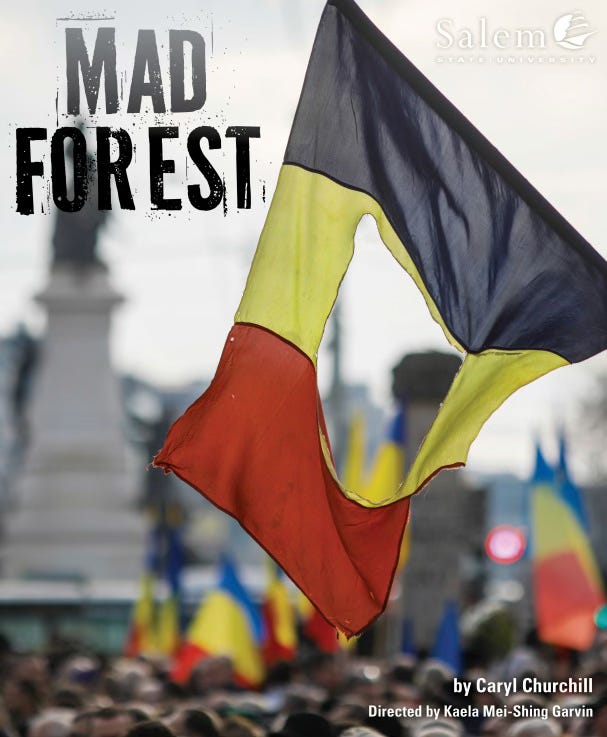
The Romanian people had enough — their standard of living was plunging and they were under constant surveillance by the Securitate, a secret police agency. Between December 16 and December 25, 1989, the oppressive Communist government led by Nicolae Ceaușescu was overthrown. After a trial that only lasted one hour, he and his wife, Elena, were executed on Christmas Day on counts of genocide and other crimes. These are the events of the Romanian Revolution, which inspired the 1990 play, Mad Forest, by English playwright Caryl Churchill. Much of Churchill’s dramatic works focus on themes of sociopolitical strife, sexuality, and oppression (mainly of women). These are evident in plays she has written, including Light Shining in Buckinghamshire (1978) and Mad Forest (1990).
Salem State University’s theater department recently held its opening night performance of Mad Forest on Friday, November 21st on the mainstage of the Sophia Gordon Center for Creative and Performing Arts. Directed by Kaela Mei-Shing Garvin, the department put on a powerful rendition of the play.
Mad Forest delivers a candid look at the events before, during, and after the Romanian Revolution. It focuses on the Vladu and Antonescu families in Acts I and III and how they navigate the sociopolitical disorder left by a collapsed regime. The production also explores the stories of ordinary citizens in Act II. These are based on interviews conducted by Caryl Churchill, along with colleagues and students from the London Central School of Drama, who traveled to Romania after the revolution. The documentary-style drama features surreal moments scattered throughout the play, reflecting the peculiar nature of sociopolitical strife. Characters appearing in these surreal scenes include angels, vampires, dogs, kings, and others. Mad Forest does require some prior reading to follow smoothly. This can be an obstacle in fully appreciating the play’s social commentary, and may not appeal to every viewer. Nonetheless, any amount of preliminary research will pay off. In the lobby, helpful infographics with key historical information are available for audiences to peruse before the doors open.
As I walked into the venue and found my seat, I took in the gorgeous set design. The stage was bathed in a violet-blue, with warm light bulbs hanging from the ceiling, like rays of hope amid the cold. There were chain-link fences with a layer of fabric, acting as partitions. Actors used these set pieces to cast their silhouettes, responding in tandem with the scenes taking place in the foreground. This use of shadows added to the play’s mesmerizing aesthetic of obscurity. The implementation of colored lights was striking, heightening emotional beats throughout the production. A standout moment that had the audience roaring was clever lighting that simulated slow motion during a wedding brawl. Overall, the dance and fight choreography in Mad Forest was solid, with only occasional instances where stage combat appeared slightly disjointed.
The superb cast had stand-out performances from the Angel (Pandora Benedito), Mihai Antonescu (Chris Raney), and Florina Vladu (Lauren Ambramson). Pandora Benedito, as the Angel, presents a juxtaposition between a seemingly benevolent divine entity and an unsettling level of malice. Chris Raney’s performance as Mihai Antonescu brought to life an emotionally unavailable, embarrassingly awkward, and out-of-touch father figure. Lauren Ambramson as Florina Vladu had the audience on the edge of their seats as she conveyed powerful emotions through gestures and precise shifts in tone. Although the production’s effort toward authentic representation deserves recognition, the Romanian accent work for certain characters could be further refined. However, when accent work was present it did little to diminish the core impact of scenes, or the overall experience of Mad Forest.
Each character had their own perspective on the revolution. What side are we on? Who is responsible for the violence and death in the streets? Was everything that happened between December 16th and the 25th just? These are questions that they must grapple with as they navigate the debris. At times during the show, cries from citizens formed a cacophony that drowned out all sense of order and conventional understanding. But the disarray subsided, and as the cast began to sing Romania’s National Anthem, “Deșteaptă-te, române!” (”Wake up, Romanian!”) I felt tears well in my eyes. The chorus rallied unity in spite of adversity, gathering people from every echelon, profession, and background. They joined under one banner—the Romanian flag with a hole where the communist emblem once stood—embodying enduring hope. In the realm between chaos and clarity, hope and tragedy, Romanians marched into an uncertain future.
In the Director’s Note, included in the program, Kaela Mei-Shing Garvin writes the “play’s refusal to simplify its ideas” solidified its ability to express “beauty in confusion.” The stage play was a moving performance that showed how revolution is never quite black or white. If you are looking for a nuanced and gripping production, then I cannot recommend Salem State University’s Mad Forest enough.